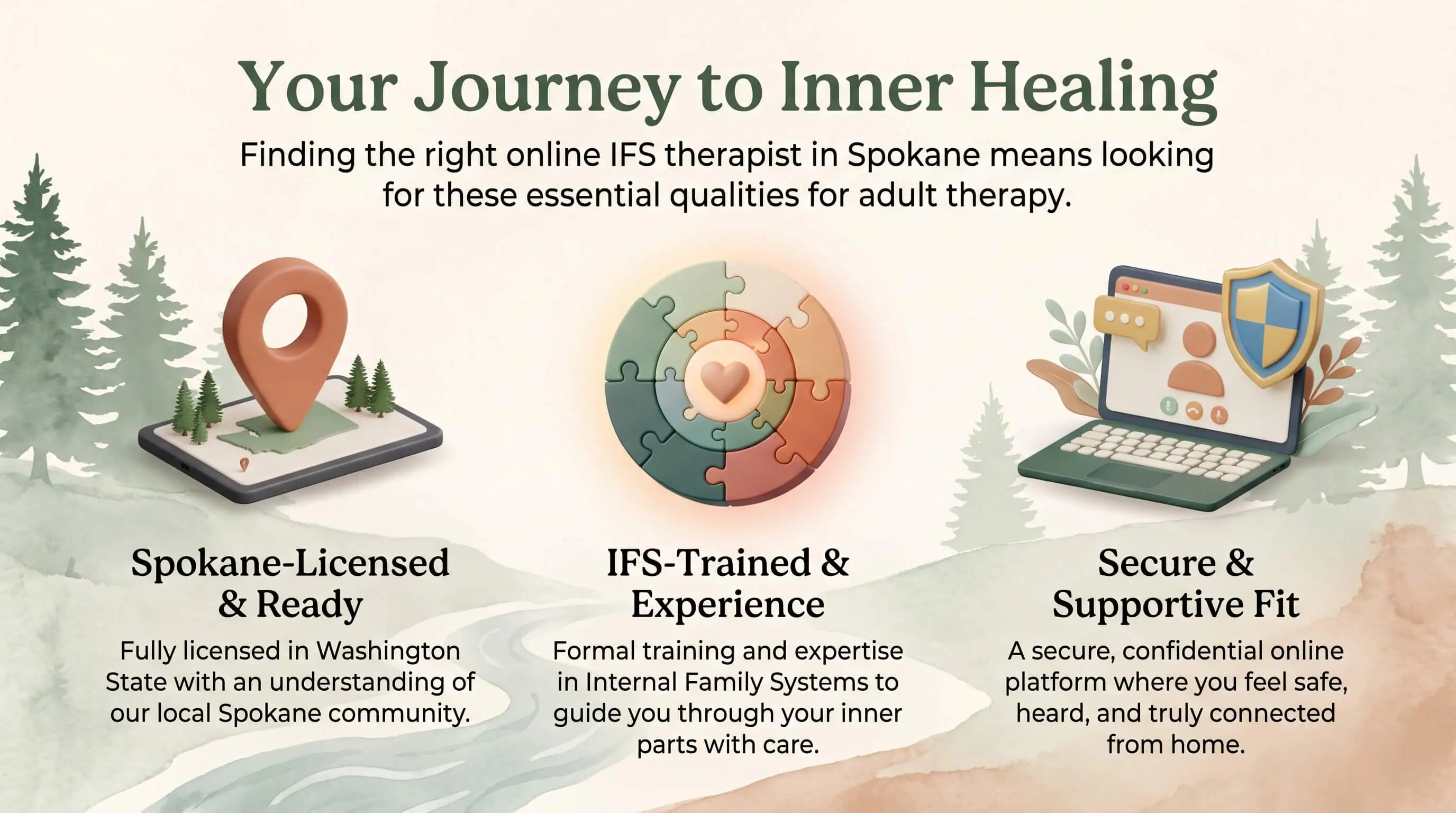
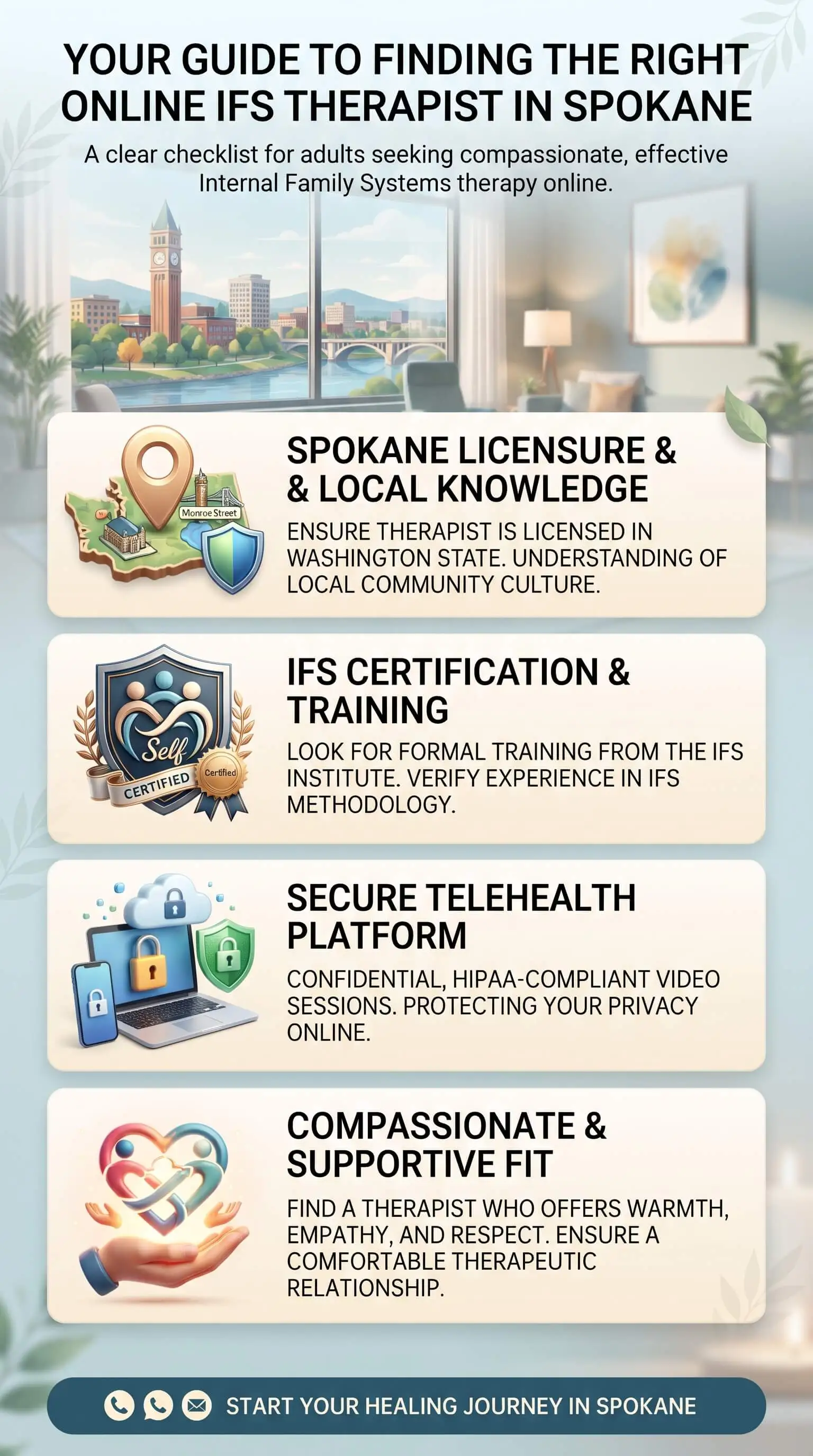
Those details are what separate a strong online IFS therapist from a well-written profile. For a Spokane therapist · IFS therapy for adults (virtual), look for a Washington license you can check yourself, formal training in Internal Family Systems (IFS), experience with the specific thing you're carrying, and a pace that feels safe. Pace is the one quality no profile can prove. It's also why a Spokane therapist who sees clients by video can be a strong choice, even if you've never driven down Division Street.
If part of you is reading this with its guard up, waiting for the pitch, that's fine. It can come along.
TL;DR Quick Answers
Spokane Therapist · IFS Therapy for Adults (Virtual)
Lauren Rath, LMHC, is a Spokane-based therapist offering Internal Family Systems (IFS) therapy to adults by secure video anywhere in Washington State. IFS helps you get to know the parts of you that worry, push or shut down, so they can finally ease off.
Who it's for: Adults carrying trauma, CPTSD, anxiety, attachment wounds or perfectionism
Format: Online sessions for clients physically in Washington during each session
Credentials: Washington LMHC, IFS Institute Level 1 trained, more than seven years in practice
Pace: Slow and collaborative, with no promised timelines
Insurance: In-network with BCBS, Aetna, Regence, Premera and Cigna, plus a Good Faith Estimate for self-pay
Not a fit for: Children, teens, couples, families or medication management
First step: A free 15-minute consult, and nothing gets decided on the call
Top Takeaways
Check The License Before The Bio. The Washington Department of Health's free search confirms any therapist's credential in about a minute.
Ask Where The IFS Training Came From. Formal IFS Institute training and a weekend parts-work workshop can look identical on a website.
Your Location Sets The Rule. A Washington-licensed Spokane therapist can see you by video anywhere in the state.
Choose Depth Over Range. A therapist who names trauma, anxiety or perfectionism as a focus has usually spent years there.
Let The Consult Call Decide. Feeling slightly steadier by minute ten is better evidence than any profile.
What IFS Therapy Is, In Plain Terms
Internal Family Systems treats your mind as a household of parts, each one doing a job, instead of as a problem you need to fix.
You've met them. One drafts tomorrow's to-do list at 11 p.m. Another goes quiet the second a meeting gets tense. A third is tired of both and would like everyone to stop. In IFS, none of them gets voted out. Most took on their roles early, usually because something needed guarding and nobody else was available.
Plenty of therapy works by stepping back and analyzing the pattern. IFS turns toward the part running it, with curiosity. When a protector feels understood, it often loosens its grip on its own.
Start With The License, Then The Training
Check the license before anything else. In Washington, that means an active credential such as licensed mental health counselor (LMHC), licensed independent clinical social worker (LICSW), licensed marriage and family therapist (LMFT), or psychologist.
The Washington Department of Health runs a free public credential search, and a lookup takes about a minute. Run it on every name on your shortlist, including the one with the most polished website.
Training comes next. The IFS Institute, founded by the model's developer Richard Schwartz, offers Level 1, 2 and 3 training plus a separate certification. A weekend workshop on parts work is a different thing, even when the bio uses the same words. Ask it plainly on a consult call: "Where did you train in IFS, and how much of your week is IFS work?"
Why Washington Licensure Matters For Online Sessions
With video therapy, the licensing rule follows you. Your therapist has to be licensed in the state where you're physically sitting during the session, wherever their own office happens to be.
That works in your favor. A Washington-licensed therapist based in Spokane can see an adult in Wenatchee, or in a town whose only clinic has a six-month waitlist. If you'll be traveling out of state, mention it early, because sessions may need to pause until you're home.
Look For Experience With What You're Actually Carrying
A generalist can help with a great deal. When what you carry has a specific shape, though, you want someone who has seen that shape many times.
IFS therapy for adults tends to fit especially well with:
Trauma and CPTSD, including the kind nobody called trauma until years later
Anxiety that hides under a calm, high-functioning surface
Perfectionism, right down to the part that wants to do therapy correctly
Attachment wounds that keep resurfacing in close relationships
When a therapist names a narrow focus, they're usually pointing to where they've spent their hours. A bio listing twenty specialties tells you something too.
Green Flags And Red Flags To Notice
A first call tells you more than any profile, mostly through how the therapist talks.
Green flags:
They bring up pacing before you do
They treat your skepticism as reasonable
They say plainly who they don't work with
Fees and insurance come up without hedging
Red flags:
A promised result or a firm timeline
Pressure to tell your hardest story in the first session
Vague answers about license or training
Cost questions that keep getting pushed to "later"
A call that leaves you feeling sold to
Afterward, check in with your body. Most people can tell within ten minutes whether they settled a little or braced harder.
When Appearance Decisions Carry Emotional Weight
Anyone weighing a cosmetic procedure knows the inner debate. One part wants the change. Another has opinions about wanting. If that sounds familiar, it helps to read about the psychology behind plastic surgery and why it's okay to want it.
IFS stays neutral on the procedure itself. What it offers is room for both parts to speak, so whatever you decide comes from steadier ground than a running argument.
Practical Fit: Insurance, Cost, And Your First Call
Care only helps if you can keep showing up for it, so raise money early. Ask whether the therapist is in-network with your plan. If you'll pay out of pocket, the federal No Surprises Act entitles you to a written Good Faith Estimate before your first session.
Most IFS therapists offer a short free consultation. Bring a few questions:
Are you licensed in Washington, and where did you train in IFS?
Who do you work with most often?
What does the first month usually look like?
Do you take my insurance, and if not, what's your self-pay rate?
After you hang up, ask yourself one more: did I feel a little more like myself by the end?
"Seven years of consult calls have taught me something simple. The people who do well with me rarely choose on credentials alone. They checked my license, yes. Then they noticed whether the part of them that showed up braced had gone a little quieter by minute ten. Verify the paperwork first. After that, trust the quiet."
Essential Resources
Bookmark these before you consult with anyone.
Walk Into Your Consult With Better Questions
The American Psychological Association covers what to ask a prospective therapist and what the letters after a name actually mean. Read it the night before your call.
Source: How To Choose A Psychologist
Look Up Any Washington License
Type in a name and you'll see the license type, whether it's active, and any public disciplinary action. It's free, and faster than reading most bios.
Source: Provider Credential Search
Hear How The IFS Institute Describes The Model
The training body for Internal Family Systems explains the approach and lays out its training path. Once you've seen it, "Level 1" or "certified" in a therapist's bio becomes much easier to judge.
Source: IFS Institute
See What Therapy By Video Involves
The federal telehealth site walks patients through behavioral health care by video, from one-on-one sessions to getting set up at home.
Source: How Do I Use Telehealth For Behavioral Health Care?
Find Out What Your Washington Plan Covers
The state's Office of the Insurance Commissioner explains mental health parity and what to do when a claim gets denied. Give it ten minutes before you accept a no from your insurer.
Source: How To Get Help With Behavioral Health
Ask For A Good Faith Estimate
If you're paying out of pocket, this CMS toolkit shows what a Good Faith Estimate should include and how to dispute a bill that lands well above it.
Source: No Surprises Act Consumer Advocate Toolkit
Know How 988 Works In Washington
Long before you'd ever need it, learn how 988 connects callers to regional crisis teams across the state, with support available in many languages.
Source: 988 Suicide & Crisis Lifeline In Washington
Supporting Statistics
Three numbers that put the search in perspective.
About One In Seven Adults Saw A Counselor In 2024
The National Center for Health Statistics puts it at 14.0 percent, rising to 20.2 percent among adults 18 to 29 and 16.9 percent among women. If you're comparing therapists tonight, you have a lot of company. Most of them started with an awkward first call too.
Source: Mental Health Treatment Among Adults: United States, 2024
More Than One In Five U.S. Adults Lives With A Mental Illness
NIMH estimates 59.3 million adults, or 23.1 percent, as of 2022. With that many adults looking for care, it pays to weigh fit as heavily as the first open slot on someone's calendar.
Source: Mental Illness Statistics
Four In Five Mental Health Facilities Now Offer Telehealth
The federal telehealth office cites a survey of treatment facilities putting the share at 80 percent. For adults across Washington, the right therapist can now live on the other side of the Cascades.
Source: Telehealth For Behavioral Health Care
Final Thoughts And Opinion
Most people who land on a page like this have already done the reading. What's left is smaller and much harder to research: whether the person on the other end of the call sounds like someone you could eventually tell the truth to.
A Few Things Worth Holding Onto:
Check the license first, then trust what you felt on the call.
A narrow focus usually means long experience with people like you.
In parts work, a slow pace is part of the care.
Be gently wary of any therapist who promises an outcome.
Our opinion: the most common mistake is waiting until you feel ready. Lauren Rath sees it in consult after consult, and readiness tends to show up after the first conversation. If a part of you is sure this is a bad idea, bring it along. It's usually working very hard to keep you safe.
Frequently Asked Questions
Q: What Should I Look For In An Online IFS Therapist In Spokane?
A: Start with an active Washington license you can verify and formal training through the IFS Institute. Then look for experience with what you're bringing in, and a pace that feels safe on the first call. That last one is hard to judge from a profile and easy to feel in conversation.
Q: How Do I Check A Washington Therapist's License?
A: Use the Washington Department of Health's free provider credential search. Enter the therapist's name to see the license type, whether it's active, and any public actions against it.
Q: What IFS Training Should A Therapist Have?
A: IFS Institute Level 1 training at minimum. Some therapists continue to Level 2, Level 3 or full certification. Ask where they trained and how much of their practice uses IFS, since "parts work" can describe many different approaches.
Q: Do I Need To Live In Spokane To See A Spokane Therapist Online?
A: No. You need to be physically in Washington during each session, and the therapist needs a Washington license. A Spokane-based therapist can see adults by video anywhere in the state.
Q: Is Online IFS Therapy For Adults As Effective As In-Person Sessions?
A: For many adults, video works well. The U.S. Department of Health and Human Services calls telehealth an effective tool for behavioral health care, and fit with the therapist usually matters more than the format. Some people find it easier to open up from their own couch.
Q: Does Insurance Cover Virtual IFS Therapy In Washington?
A: Often. Many Washington plans cover telehealth therapy with an in-network provider, so ask the therapist which plans they accept and check your benefits. Self-pay clients are entitled to a Good Faith Estimate before starting.
Q: How Long Does IFS Therapy Usually Take?
A: Longer than anyone hopes, and it varies a lot. Some people notice a shift within a few months, while deeper trauma work can run a year or more. Change tends to arrive quietly. You often spot it in hindsight, when a reaction you expected simply didn't come.
Q: Who Is IFS Not The Right Fit For?
A: IFS adapts to many people, but an individual therapist may not suit you if you need couples work, care for a child, medication management, or a primary focus on substance use. A good therapist will say so on the first call.
Q: What Happens On A Free Consultation Call?
A: Usually about 15 minutes. You share a little about what's bringing you in, ask your questions and get a feel for the person. Nothing gets decided, and you don't owe anyone a yes.
Q: What If I'm In Crisis Right Now?
A: Private therapy practices aren't crisis services. If you're in immediate danger, call or text 988, or dial 911. Someone answers around the clock.
Take The First Small Step
You don't need a tidy explanation before you reach out. A free 15-minute call with a Spokane-based IFS therapist is enough to start, and nothing has to be decided on it. One sentence about what's going on will do.
Book A Free Consult · Free, 15 minutes, no pressure.


